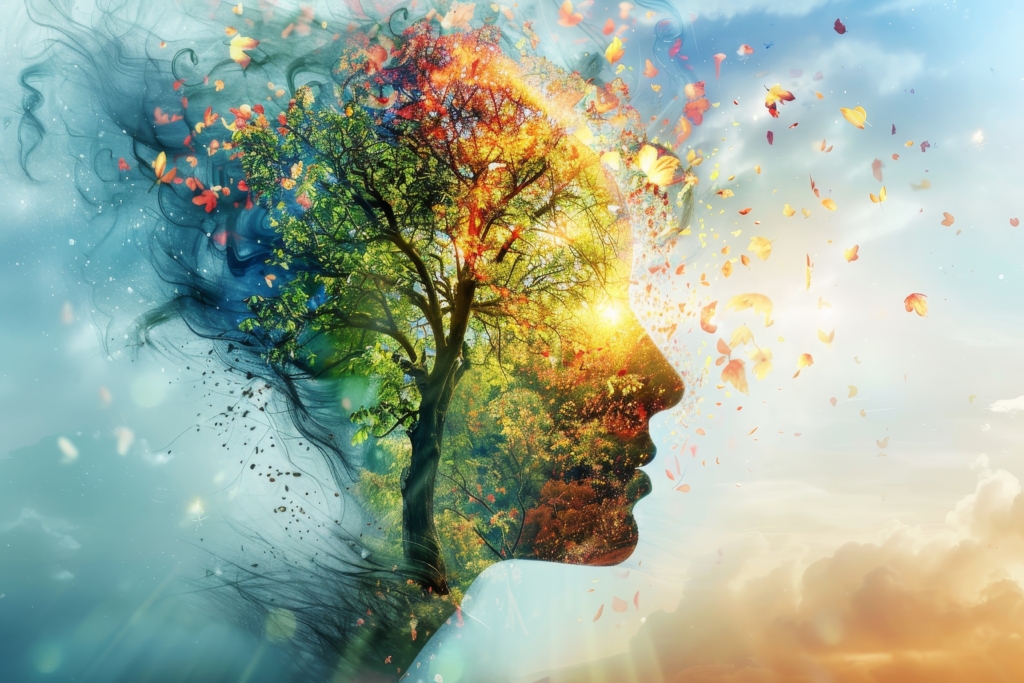
The Path of Inquiry
Today I would like to talk about the connection between Gestalt psychotherapy, an approach recognized and effective in the treatment of various mental disorders, and Eastern spiritual practices.
For more than ten years I have followed a path of both spiritual and therapeutic inquiry. Along the way I have tried many kinds of meditation, and for me they have been tools of transcendence: a way to go beyond the relative, dualistic mind, the one that divides the world into right and wrong, inside and outside, me and others. I have been fortunate to get to know several great spiritual paths, from shamanism to Hinduism, from Buddhism to Taoism, and I have seen that, beyond their differences, these paths meet and share similarities in their vision.
What I have sought most in spirituality is to know myself and to develop the mind’s capacity to contemplate itself. Knowing your own mind helps you navigate daily life better, like a sailor learning to read the sea. It means quieting the noise, which is often the echo of the past or the restless shadow of the future, and rediscovering the true nature of existence. The various disciplines give it different names, but the meaning changes little, and here I will not dwell on the details.
What I want to share is that both Eastern approaches and Gestalt therapy, which can be integrated, offer the possibility of knowing ourselves and finding our way better in life. They do so by going beyond doctrines, to experience directly the reality that surrounds us.
What does this mean, concretely? That these practices allow us to rediscover our human nature, that is, the natural state of our essence.
The Natural State in Eastern Traditions
In spiritual practices, “natural mind” means the mind before any construction, like a lake when the wind drops and the surface becomes clear again. Each tradition has its own names for that lake:
- • Buddhism: the natural mind (prabhāsvara-citta, “clear light mind”) is the luminous nature of the mind, untouched by thoughts. Rigpa, in Tibetan, is pure, naked awareness, a central term in Dzogchen.
- • Zen: the original mind (honrai no menmoku, “original face”) is the state before the distinction between subject and object, the face you had before you were
- • Tantric Shaivism of Kashmir: Spanda is the pulsation and Cit the original consciousness, a subtle heartbeat that sustains everything that exists. • Hinduism: Ātman is the Self, the essential nature of the person. •
- Taoism: Xu (虛) and Jing (靜), emptiness and stillness, are the condition of the mind that reflects the Dao like a mirror. Fan pu gui zhen (返璞歸真), “return to the uncarved, return to the truth,” indicates the return to our original nature.
- • Hinduism: Ātman is the Self, the essential nature of the person.
The names differ, but they point in the same direction: the natural state is not built, it is recognized, because it is already there, available to us. It is like the sun behind the clouds: practice does not light it, it clears away what covers it. In Dzogchen and Taoism, in fact, practice serves to remove obstacles, not to change something.
The Natural State in Gestalt: Feeling, Thinking, Acting
In Gestalt therapy the natural state is the integrity of what I feel, of what I think about what I feel, and of what I do with what I feel and think. Emotions, thoughts and actions stop being three voices that speak in turn, or worse, over one another, and become a single melody. We become something whole and solid, but solid does not mean rigid. Think of a tree with deep roots that bends in the wind without breaking. In all disciplines we look for this softness combined with centeredness, a sharp and alert presence.
Yin and Yang: Balance Between Two Poles
In the approach of traditional Chinese medicine, as master Mu Yuchun transmits it, psychophysical health arises from a magnetic field that surrounds us, outside and within, and that we can feel through our body by doing certain practices. Mu Yuchun is a great Chinese master, whose translator I have had the honor of being for five years, and whom I accompany as he transmits the ancient knowledge of his family, which comes from the world of Wushu. Through this magnetic field, to which we all have access, it becomes possible to rebalance the imbalances of the body and find the point of union where psychophysical balance arises.
In daily life we constantly apply the principle of yin and yang. We need to balance the analytical and the intuitive, thinking and feeling. When we need to flow and let go, yin energy comes into play, like water finding its way. When we need to activate ourselves and be determined, we use yang energy, like fire igniting movement.
Gestalt psychotherapy says the same thing in a different language: everything is a gestalt, that is, a single form in which two opposites move to create unity. They are never separate opposites, but two wings of the same bird. This is why in therapy we work on polarity. If you live with a lot of apathy, what do you do with your anger? If you are always agitated, how can you reach your calm? If you are sad, where do you hide your anger and your frustration? What gives you pleasure?
Yin and yang also act in relationships. If yang prevails in one partner, it will be easier for him to get angry and to express himself in a concrete way. To feel well, we need to know how to express our yang (fire, action, determination, active and outgoing inner movement) but also our yin (flowing, intuiting, softness, descending and more introverted movement), as the present situation requires. And let us remember that yin and yang constantly exchange places: they do not stand still, but turn in a circle, in a spiral, and show themselves in a continuous dance of exchange and enfolding.
Earth, Sky and the Human Being in the Middle
Another important principle, fundamental in Taoism, which I discovered through direct experience with master Mu Yuchun, is that of earth, heaven and the human being in the middle. Beneath our feet is the earth, our mother who welcomes and offers support. Above us is heaven, our father, who gives direction and acts as our compass. The human being is the bridge between the two and draws from both.
This principle gives me a sense of safety, especially the feeling of being welcomed, supported, and able to move through the world with more freedom. For this reason we need to stay present and attentive to what is there and to the effect it has on me. With the horizontal and vertical dimensions together, our gaze widens and becomes less fixed on a single detail, sparing us tunnel vision.
There is also a principle that greatly affects the quality of life: intention. Where does our gaze go, literally and metaphorically? It is worth cultivating an intention toward something that inspires us, that excites us, that we enjoy experiencing. Intention is like the lantern of a boat: it lights the course we are truly choosing.
The Center and the Contemplation of the Mind
In many practices, and especially in Taoism, we work for a long time on our center: this is what we call “feeling centered.” It is the state in which we can listen deeply to what happens inside the body and outside (interoception and proprioception). Between inside and outside a freer exchange arises, like a door that finally opens in both directions. From here come contemplation, the possibility of being ourselves in a natural way, and an intuition that develops together with an ever wider and deeper integration.
Grounding, rootedness, adds resilience and mental stability: it is the ballast that keeps the boat from capsizing when the wind changes.
When we stay in authentic contact with our center, we enter a state of universal love, compassion and contemplation. The focus of attention shifts, and something more in line with our authentic nature of that moment begins to happen. We let go, but remain active and attentive to what we feel. We feel our strength and our presence, we become wiser and less reactive.
When we are able to contemplate our own mind, we reach a state of peace, of subtle presence, of union between inside and outside. We can call it the emptiness that is actually full, like the silence of a room that holds all the music before anyone plays it.
Thus, without obstructing the process, we begin to truly contact our emotions and bodily sensations. We enter a fuller and more honest relationship with ourselves, and awareness grows, as if we were rising to another level of our consciousness. We can navigate our inner world with more creativity, including the less conscious parts, which we often call the shadow. At that point we choose how to act with wisdom in every moment of life, and we express ourselves in a spontaneous and creative way
The Master and Integration
I am fortunate to be able to contemplate master Mu Yuchun, a master of Chinese martial arts. I am struck by the way he moves through the world, whole, in all his totality. His movement is fluid and at the same time solid, like a river within a bed of rock, and he moves the energy within and around himself. You can imagine it, but you can also live it within yourselves. It is an all-encompassing phenomenon, when one becomes aware of the full integrity between fluidity, speed, softness and rootedness. The transformation happens right in this moment.
It tells us how important it is to seek integration, for personal growth and for a better quality of life. Integration, wholeness, means uniting mind, heart and actions, day after day, instant after instant.
The way we live and act is reflected in our life: what we think and what we do has direct consequences, like the ripples a stone leaves on water. Gestalt, which is an existential approach, places great value precisely on the responsibility of choice.
For this reason, cultivating the natural state is fundamental for psychophysical wellbeing in general, and we can see it through different approaches and lenses.
Imagination as a Bridge to Transcendence
In many practices imagination is the tool that ignites something beyond ourselves, a spark that carries our gaze further. In Dzogchen, for example, one visualizes specific letters or yantras, or manifests as a reflection of light or a rainbow, with all five elements together. In martial arts the intention goes even further: master Mu Yuchun says that where the soul goes, that is, beyond the visible, there we go to seek the invisible. Imagination, then, is already in itself a tool toward transcendence.
The Next Movement
This brief look at these practices reminds us how important it is to become more and more present and aware of what happens inside and outside of us. There are many methods for doing this, and each person may resonate with the one that suits them best, as every person has their own instrument. I have shared with you what calls to me most and what I have lived most along my path.
Gestalt psychotherapy is the proper space to know oneself and one’s authentic nature. It is not an esoteric space: it is the place where we can lay ourselves bare with our own soul, put ourselves in play and contemplate, with a clearer lens, what we are living here and now. In sessions I integrate meditative and body practices according to the needs and specific requests of the people who come to me.